Redesigning Income Tax Declaration for an Entire Country
Leading UX design for a nationwide income declaration wizard for the Lithuanian State Tax Inspectorate (VMI), increasing annual declarations by 300k to 1.6M users.
- Role: Senior UX Designer
- Timeline: 2017 - 2018
- Platform: Web
Executive summary
In 2019, the Lithuanian State Tax Inspectorate (VMI) launched a new income declaration wizard that fundamentally transformed how residents declare annual income. Replacing complex, table-based electronic forms with a question-and-answer flow, the solution enabled citizens to complete declarations faster, with fewer errors, and often without external help.
Key results achieved after launch:
- Income declarations increased from 1.3 million (2018) to approximately 1.6 million (2019)
- 74% of taxpayers with fully known income data could submit a declaration with a single click, often in just a few minutes
- The wizard became accessible to over 2 million permanent Lithuanian residents
- Reduced error rates and lower demand for VMI customer support
- Awarded Naujasis Knygnesys 2020 prizes: Best Solution for Lithuania and People’s Choice
The project was delivered in collaboration with NRD Systems, with NFQ UX and design specialists responsible for user experience and interface design.
Context & problem
For years, Lithuanian residents could declare income electronically, but the system was essentially a digital copy of paper tax forms introduced in 2004. While technically functional, it no longer matched modern user expectations or behaviors.
Key challenges in the existing system
- Long, technical, accounting-style forms that were difficult to understand
- High error rates and frequent user confusion
- Citizens often forgot to declare certain income types or were unaware they were required to
- Many users hired accountants solely due to system complexity
- Poor accessibility for mobile users, non-Lithuanian speakers, and people with special needs
Although more than 1 million declarations were submitted annually, the process was time-consuming, intimidating, and discouraged timely compliance.
Goals & objectives
The primary task was to design a system that would allow an average Lithuanian resident to declare income as simply and independently as possible.
The project objectives were:
- Simplify income declaration without oversimplifying tax logic
- Reduce errors and uncertainty during the declaration process
- Enable citizens to complete declarations quickly and confidently
- Ensure accessibility across devices, languages, and user abilities
- Prepare the system for future changes in tax legislation
The solution needed to operate within Lithuania’s complex and evolving tax framework, including different income classes (A and B) and strict security and privacy requirements.
Process & solution
A human-centered design approach was applied throughout the project, following ISO 9241:210 principles and involving continuous collaboration between designers, developers, VMI specialists, and users.
Key actions taken:
User research and analysis
- Conducted two large-scale surveys
- 416 taxpayers
- 161 VMI customer support specialists
- Reviewed historical research data from nearly 10,000 system users
- Performed 12 moderated usability observations using real declarations
- Identified seven key user groups, including employees, freelancers, students, farmers, expatriates, and tax professionals
Key insights
- Plain, human language instead of legal or accounting terminology
- Step-by-step guidance toward a clear goal
- Minimal manual data entry
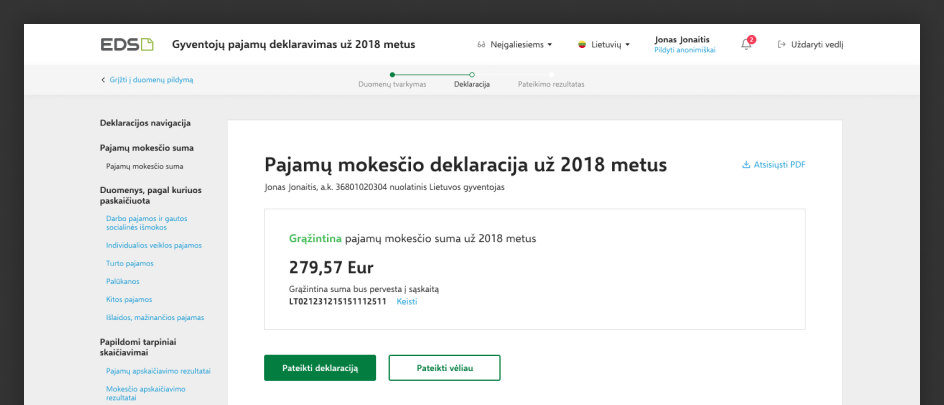
- Immediate visibility of payable or refundable amounts
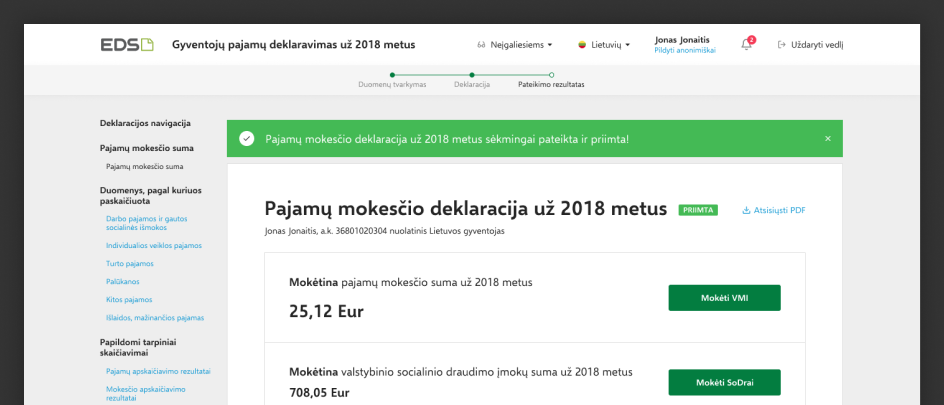
- Ability to pay taxes directly from the declaration
- Mobile access, multilingual support, accessibility features, and built-in error prevention
Design and iteration
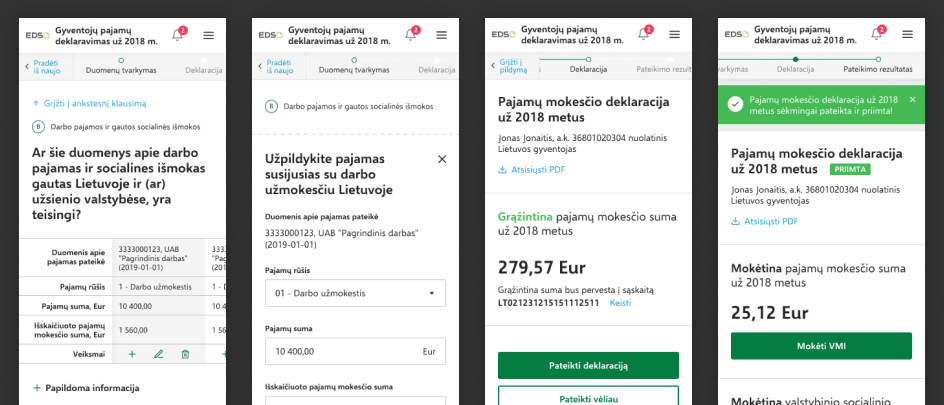
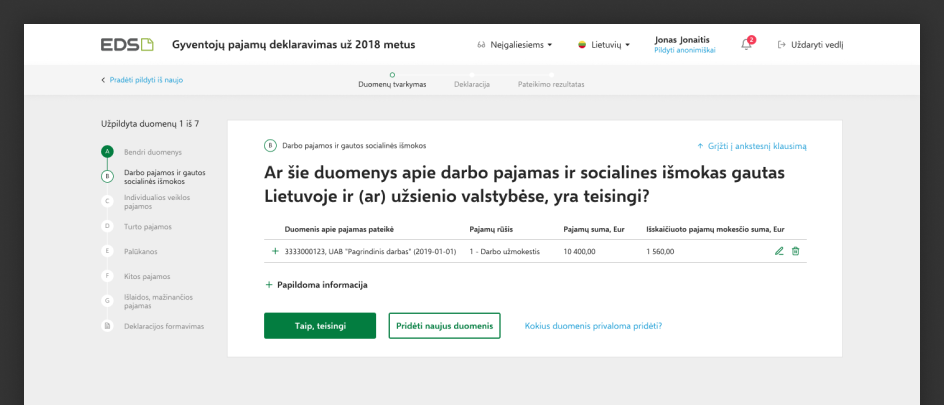
- Replaced static forms with a guided question-and-answer flow
- Automatically pre-filled income and expense data already known to VMI
- Designed the wizard to adapt dynamically based on user answers
- Developed and tested over 40 prototype iterations, from low-to-high-fidelity
- Conducted usability testing with 12 participants representing core user groups
- Created a scalable design system and full UI specifications
Content and collaboration
- UX designers co-created copy with VMI to ensure clarity and plain language
- Balanced user needs with strict security and privacy requirements
- Maintained close alignment with VMI stakeholders who supported UX-driven decision-making
Outcome & impact
The income declaration wizard replaced one of the most complex public digital services in Lithuania with a clear, accessible, and user-friendly experience.
Measured and observed outcomes:
- Declaration completion time reduced from hours to minutes in standard cases
- Errors and incomplete submissions decreased significantly
- Citizens gained confidence to declare income independently
- Reduced customer support workload for VMI staff
- Encouraged broader participation in income declaration
Broader impact:
- More efficient tax collection
- Increased transparency and trust between citizens and the state
- Improved accessibility and inclusion
- Positive long-term impact on Lithuania’s economic competitiveness
The project demonstrated how user-centered design can transform a nationwide, legally complex public service without compromising accuracy, security, or trust.